

Couch & Sofa Reupholstery in Monmouth County, NJ
Professional sofa reupholstery for standard couches, sectionals, sleepers, loveseats, and more. Custom fabric selection and full structural repair in our local studio.
Reupholster Your Sofa, Do Not Replace It
Your couch is probably the most used piece of furniture in your house. It is the first thing you drop onto after work. It is where your kids sprawl out for movie night. It is the spot where the dog has quietly claimed the left cushion as his own personal territory for the last five years. All that living adds up, and at some point the fabric starts telling the story a little too honestly. Flattened cushions, worn armrests, stains that stopped responding to spot treatment a long time ago.
Get a Free Estimate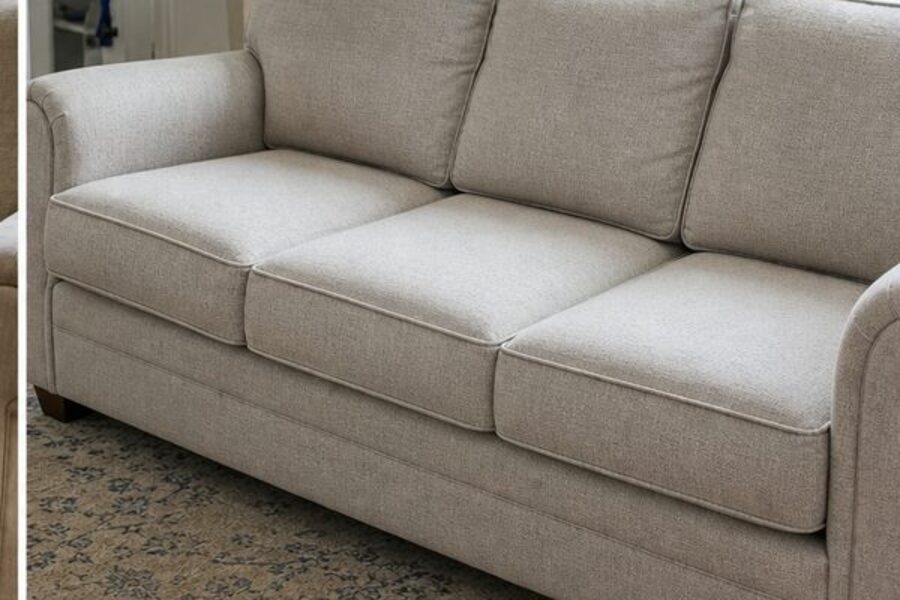
Why Your Frame Is Worth Saving
Here is the thing most people do not realize. The actual structure of your couch (the hardwood frame, the joinery, the bones of the piece) is almost certainly in better shape than anything sitting on a showroom floor right now. Mass-produced sofas built in the last decade rely heavily on stapled softwood, particleboard, and glue. They are designed to last five to seven years and then get hauled to the curb. Your older couch, especially if it was built with a kiln-dried hardwood frame and proper doweled or mortise-and-tenon joints, was designed to last decades. The frame is not the problem. The upholstery is.
Reupholstering lets you keep what is already good about your sofa and fix what is not. We strip the old fabric, inspect every inch of the frame, repair anything that needs attention, replace the foam and padding throughout, and wrap the whole thing in whatever fabric you choose. You end up with a couch that feels brand new. Better than new, actually, because the frame underneath has the kind of build quality that most manufacturers have quietly stopped offering.
The financial side makes sense too. A quality new sofa runs anywhere from $2,000 to $5,000 or more depending on what you are looking at. Reupholstering that same caliber piece typically costs 40 to 60 percent of the replacement price, and you get to keep the exact dimensions, proportions, and character you already know you like. No guessing whether a new couch will actually fit through your doorway. No hoping the online color looks the same in your living room. No settling for the three fabric options the manufacturer decided to offer this season.
At Coastal Craft Upholstery, we work on every type of couch and sofa that comes through our studio here in Monmouth County. Standard three-seaters, sectionals, sleeper sofas, loveseats, chesterfields, mid-century modern pieces, camelbacks, and everything else. We offer over 1,000 fabrics ranging from performance textiles that shrug off spills and pet claws to premium linens and velvets that turn a living room into something out of a design magazine. Text us some photos, stop by the studio, or give us a call. We will tell you straight whether your couch is worth reupholstering and what it will cost.
Every Style of Couch, Handled Right
From everyday family sofas to heirloom pieces with serious craftsmanship, we work on all of them.
Standard Sofa
Three-seat couches, the backbone of every living room
Sectional
L-shapes, U-shapes, modular configurations
Sleeper Sofa
Pull-out beds with mechanism-friendly upholstery
Loveseat
Compact two-seaters for smaller spaces
Chesterfield
Deep button tufting and rolled arms
Mid-Century Modern
Clean lines, tapered legs, minimal profiles
Camelback
Arched backs with exposed wood legs
The Workhorses of Every Living Room
Standard three-seat sofas make up about half of the couches that come through our shop. These are the pieces that anchor your living room, the 80-to-90-inch frame that the whole family gravitates toward every evening. After ten or fifteen years of daily use, the cushions flatten out, the armrests show wear lines, and the fabric starts looking tired even if the frame underneath is still rock solid.
What the Process Looks Like
Reupholstering a standard sofa gives you the chance to pick a completely new look while keeping the exact proportions and seating depth you have already grown comfortable with.
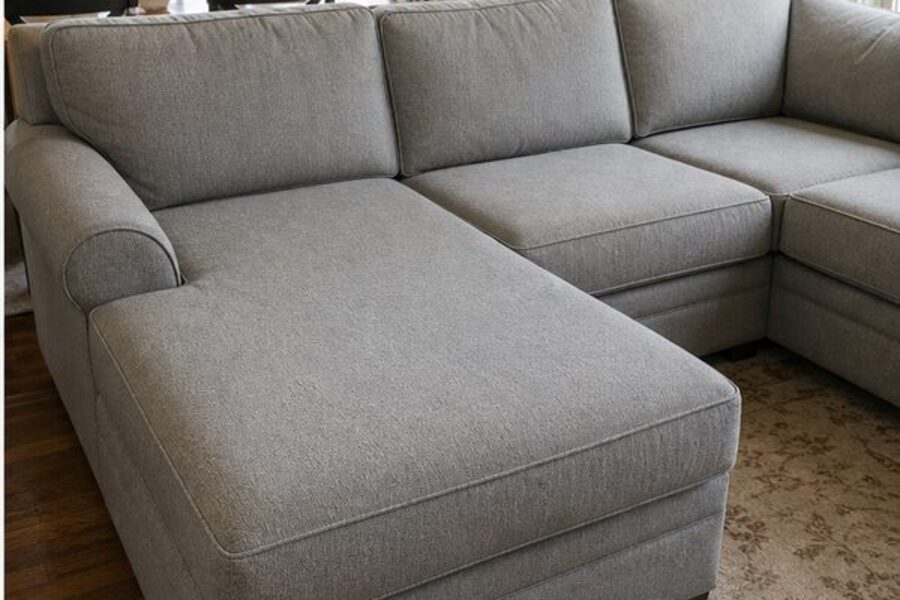
Sectionals are our most labor-intensive projects, but they are also some of the most rewarding. A large L-shape or U-shape sectional can have anywhere from three to seven individual sections, each with its own cushion configuration and connection hardware. We disassemble each section individually, strip the fabric, repair any structural issues, install new foam throughout, and reupholster each piece separately before reassembling the entire unit. Fabric pattern alignment across sections is critical. A mismatched stripe or a visible seam where two sections meet will jump out at you every time you sit down. We cut and sew all sections as a coordinated set to prevent that.
Modular sectionals require extra attention to the connection points. The brackets, clips, or Velcro strips that hold sections together need to be in perfect alignment after reupholstery or the sections will shift apart during use. We test-fit every connection before the sofa leaves our studio.
Sleeper Sofas and Loveseats
Sleeper sofas present a unique challenge because the fold-out mattress mechanism sits inside the frame and the upholstery has to accommodate it without bunching or restricting the pull-out action. We remove the mechanism entirely before stripping, service all the moving parts (hinges, springs, frame welds, locking bars) and reinstall it after the new fabric is in place. The upholstery around the mattress cavity needs to be cut precisely so the bed opens and closes smoothly without catching on fabric folds. We test the mechanism multiple times before considering the job done.
Loveseats are the most straightforward couches to reupholster. Their compact two-seat design uses less fabric, takes less labor time, and costs significantly less than a full-size sofa. If you have a loveseat and a matching sofa, we always recommend doing both at the same time so the fabric matches perfectly. Dye lots can vary between fabric orders, so doing them together eliminates any risk of a subtle color difference.

Specialty Sofas That Deserve Expert Hands
Chesterfields are among the most complex sofas to reupholster properly. The deep button tufting that defines the style requires precise diamond-pattern layout, consistent pull depth at every tufting point, and careful fabric management to avoid puckering between buttons.
Get a Specialty Sofa QuoteThe Art of Hand Tufting
Each button is individually tied through the padding and anchored to the frame with heavy twine. A standard chesterfield sofa can have 40 to 60 tufting points across the back and arms, and every single one needs to be uniform. We use the same traditional hand-tufting methods that these sofas were originally built with because machine shortcuts produce results that look flat and lifeless. If you have a chesterfield with the original horsehair padding, we can often restore and supplement the existing fill rather than replacing it entirely, which preserves the authentic feel of the piece.
Mid-Century Modern Sofas
Mid-century modern pieces from the 1950s through the 1970s are some of our favorite projects. These sofas were built with incredible attention to proportion and line. The frames are typically low-profile with tapered wood or metal legs, minimal arm height, and tight, structured cushions that do not rely on overstuffed padding for their look. Reupholstering a mid-century sofa requires fabric with the right weight and hand, something that drapes cleanly over the minimal padding without bunching or wrinkling. We often work with wool blends, tweed-look wovens, and structured linens that complement the architectural nature of these designs. If the original legs need refinishing, we handle that as part of the project so the whole piece looks cohesive when it goes back in your room.
Camelback Sofas
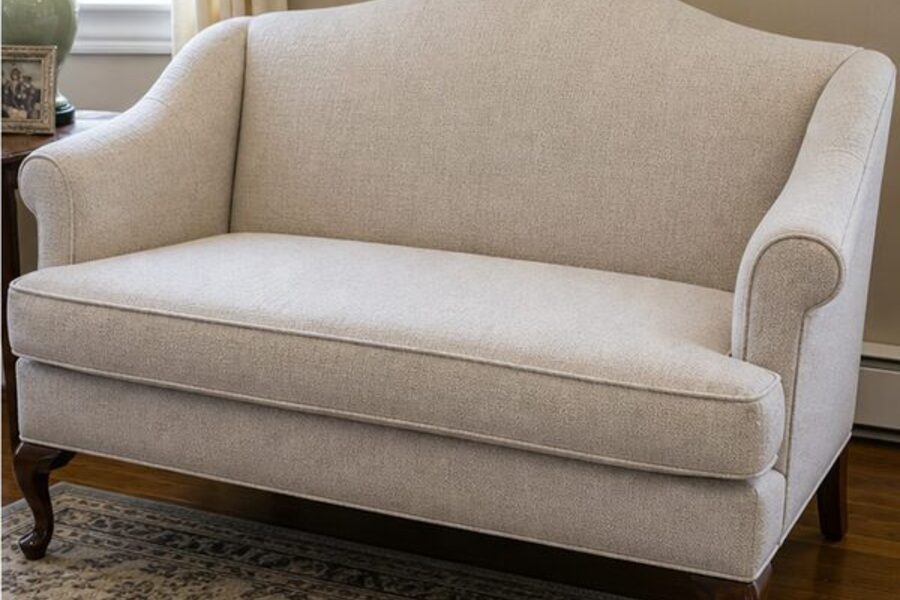
Camelback sofas get their name from the arched back that rises to a peak in the center and curves downward toward the arms. This distinctive silhouette requires precise fabric cutting and sewing to follow the contour without rippling or pulling. The curved back panels are some of the most technically demanding cuts in upholstery work because the fabric needs to stretch smoothly over a three-dimensional curve while maintaining even tension throughout. We template each camelback individually because the exact curve varies between manufacturers and eras. If your camelback has exposed wood legs and arm details, we protect and refinish those as part of the reupholstery process. These are statement pieces that deserve to look their absolute best.
Common Couch Problems We Fix Every Day
If any of these sound familiar, your sofa is a strong candidate for reupholstery rather than replacement.
Sagging Cushions
Foam breaks down over time and loses support. We replace with high-density foam cut to your exact specifications.
Worn & Stained Fabric
Fading, pilling, tears, and deep stains that cleaning cannot touch. New fabric transforms the whole piece.
Broken Springs
Poking through cushions or creating uneven support. We retie, replace, or install new spring systems.
Pet Damage
Scratches, chewing, hair embedded in weave. We repair the damage and can use pet-proof performance fabrics.
What Is Actually Wrong With Your Sofa
Most people call us and say something like "my couch is shot" or "this sofa is done." But when we dig into the specifics, the actual problem is usually one or two specific things rather than total failure. Identifying exactly what needs fixing is the first step to figuring out whether reupholstery makes sense and what it will cost.
Send Us Photos for a Free Assessment
The Cushion Test
Sit in the center of your sofa and pay attention to where your body stops sinking. If you bottom out against the frame or the springs underneath, the foam has lost its density and needs replacing. If the cushion still has some bounce but the surface is lumpy or uneven, the batting layer on top has shifted or broken down. Pull the cushion out and squeeze it in your hands. Good foam springs back immediately to its full height. Dead foam stays compressed or returns slowly and unevenly. This is the single most common problem we see, and it is the cheapest and fastest to fix. Cushion foam replacement without full reupholstery can transform how your couch feels in a single day.
The Fabric Assessment
Run your hand across the fabric on the armrests, the front edge of the seat, and the headrest area. These are the three highest-wear zones on any sofa. If the fabric is thinning, pilling, or feels noticeably different in these spots compared to the back or sides, the material is wearing through and will eventually develop holes. Stains that no longer respond to professional cleaning have usually penetrated past the surface into the padding underneath, which means even replacing the fabric alone will not eliminate the discoloration entirely. The padding needs attention too. If the fabric has faded unevenly from sun exposure, that is cosmetic damage that only new fabric can fix.
The Structural Check
Sit on one side of the sofa and then the other. If one side sinks noticeably lower, a spring has likely failed or a section of webbing has stretched. Rock the frame side to side with your hands. Any movement or creaking indicates loose joints that need regluing. Lift one end of the couch off the floor. Heavy means hardwood frame, probably worth saving. Light means softwood or engineered materials, which may or may not justify the investment depending on overall condition. Look underneath if you can. A frame with corner blocks, doweled joints, and smooth-grained hardwood is the kind of piece that reupholstering makes obvious financial sense for.

New Foam That Actually Holds Its Shape
The cushions on your couch are the first thing to go. Standard furniture foam starts losing its density after about five to seven years of regular use. By the ten-year mark, most cushions have compressed to the point where you can feel the frame through the padding.
Get a Cushion QuoteFoam Density and Why It Matters
Not all foam is created equal, and this is where a lot of furniture manufacturers cut corners. The foam inside mass-produced couches typically ranges from 1.5 to 1.8 pounds per cubic foot in density. That is the bare minimum for sitting on, and it compresses quickly under repeated use. When we replace your cushion foam, we start at 2.0 pounds per cubic foot and go up from there depending on your preference. High-resilience foam at 2.4 to 2.8 density gives you that firm-but-comfortable feel that bounces back to its original shape every single time you stand up. If you want something softer, we can layer a high-density base with a softer top layer so you get the sink-in comfort without bottoming out against the frame.
Dacron Wrapping and Cushion Crowning
Raw foam on its own does not look great inside a cushion cover. It tends to show edges and corners through the fabric. We wrap every foam insert in a layer of Dacron polyester batting before it goes into the cover. This smooths out the surface, rounds the edges, and gives the cushion that plump, overstuffed look that makes a sofa feel expensive. We also crown the foam slightly, cutting it a fraction taller than the cushion cover dimensions, so the finished cushion fills out completely without bunching or wrinkling. This is one of those small details that separates professional work from a DIY foam swap.
Seat Cushions vs. Back Cushions
Most couches use different padding systems for seat cushions and back cushions. Seat cushions need high-density foam because they carry your full body weight. Back cushions usually get a softer fill: polyester fiber fill, blown fiber, or a combination of loose fill and a foam core. When we rebuild your sofa, we address both. A lot of couches come in with good seat cushions but completely flat, lumpy back cushions that have shifted and settled into dead spots. We rebuild back cushions from scratch, distribute the fill evenly, and add chambers or baffles where needed to keep everything in place long-term.
If your couch cushions have gone flat but the frame and fabric are still holding up fine, cushion replacement on its own is an option. We pull the old foam, cut new inserts to the exact same dimensions, wrap them, and slide them back into your existing covers. It takes a day or two and costs a fraction of a full reupholstery job. It is one of the best bang-for-your-buck upgrades you can do for a living room.

Fixing the Support System Under Your Cushions
Springs are the hidden support system that gives your couch its feel. When they fail, you notice it immediately. You sit down and one side sinks lower than the other. You feel a hard spot poking through the cushion. The problem is underneath, and it needs professional attention.
Get a Spring Repair QuoteTypes of Spring Systems in Sofas
Most couches use one of three spring systems. Eight-way hand-tied coil springs are the gold standard: individual coil springs anchored to the frame and connected to each other with twine in eight directions. This is what you find in high-end furniture and well-built older pieces. Sinuous springs, sometimes called S-springs or zigzag springs, are the serpentine wire strips that run front to back across the seat. These are more common in mid-range furniture and are simpler to repair or replace. Webbing-based systems use interwoven elastic or jute straps instead of metal springs. Each system has its own repair approach, and we work with all of them.
What Goes Wrong and How We Fix It
Eight-way hand-tied springs lose their tension when the twine breaks or stretches. When one spring drops, the surrounding springs take on extra load and start failing too. We retie the entire spring deck using heavy-duty spring twine, replacing any coils that have lost their temper or broken. For sinuous springs, the most common problem is clips snapping off the frame or the wire itself bending out of shape. We replace damaged clips, straighten or swap out bent springs, and add new ones where the spacing has become too wide. Webbing systems stretch and sag over time, and we replace them with fresh elastic or jute strapping pulled to the right tension across the frame.
Spring repair is almost always part of a full reupholstery job. We check the entire spring system while the old fabric is off and make repairs before the new padding goes on. If your springs are shot but the fabric is still decent, we can do spring work as a standalone service. You do not need to commit to a full reupholstery if the springs are the only issue. We will tell you honestly what needs to happen and what can wait.
Solid Bones Make Everything Else Work
The frame is the skeleton of your couch. If it is cracked, loose, or warped, nothing else we do will matter because the sofa will still feel wrong when you sit on it. Frame inspection is the first thing we do on every reupholstery project.
Get a Frame Assessment
Common Frame Problems
Loose joints are the most frequent issue. The glue dries out over the years, dowels shrink, and the joints start wiggling. You hear creaking when you sit down or shift your weight. We disassemble the loose joints, clean out the old adhesive, and re-glue everything with modern wood glue that creates a bond stronger than the wood itself. We add corner blocks and steel brackets where needed for extra reinforcement. Cracked rails (the horizontal pieces that run along the arms and back) are the second most common problem. These usually crack from impact or from someone sitting on the arm of the couch repeatedly. We splice in new wood, reinforce the repair, and make sure the structural integrity is better than the original.
When a Frame Is Not Worth Saving
We will always be straight with you about frame condition. If a couch was built with particleboard or stapled softwood and the frame has failed in multiple places, pouring money into repairs does not make sense. We will tell you that. It happens maybe one out of every fifteen or twenty couches we look at. For the other nineteen, the frame is perfectly good and worth the investment. Hardwood frames from the mid-century era through the 1990s are especially solid and are almost always worth reupholstering. Even some newer frames built with kiln-dried hardwood hold up well. We will give you an honest assessment before any work starts.

Choosing the Right Fabric for Your Life
Fabric selection is the most important decision in any couch reupholstery project, and it is also the most fun. We keep over 1,000 fabric and leather samples in our studio, and we can order from dozens of additional suppliers if you have something specific in mind.
Browse Fabrics With UsPerformance Fabrics: the Smart Choice for Families
If you have kids, pets, or just a busy household where the couch gets heavy daily use, performance fabrics are the way to go. These are engineered textiles built specifically for high-traffic residential use. Crypton is one of the most popular options. It has a moisture barrier built into the fiber itself that prevents liquids from soaking through, and it resists staining at a molecular level. You can literally pour red wine on a Crypton-covered cushion, wipe it with a damp cloth, and it comes clean. Revolution Performance fabrics use a recycled polyester fiber that is naturally stain-resistant without any chemical treatments. Sunbrella, which most people associate with outdoor furniture, makes an excellent indoor line that handles everything from juice boxes to muddy paws. All of these fabrics come in hundreds of colors, patterns, and textures. Performance fabric does not mean you are stuck with boring options.
Natural Fibers: Cotton, Linen, and Wool
Natural fiber fabrics look and feel incredible. A heavy linen on a mid-century sofa has a texture and drape that no synthetic can quite replicate. Cotton velvet on a chesterfield catches light in a way that makes the whole room feel warmer. Wool blends are naturally resilient and have a soft hand that improves with age. The trade-off is durability. Natural fibers stain more easily, wear faster in high-traffic spots, and require more careful maintenance. We recommend natural fibers for formal living rooms, guest rooms, or any space where the sofa does not take daily abuse. If you love the look of linen but need the practicality of a performance fabric, several manufacturers now make linen-look synthetics that are nearly indistinguishable from the real thing. We keep samples of those in the studio too.
Velvet: Not as Delicate as You Think
Velvet has had a major comeback in the last few years, and for good reason. A velvet sofa makes a statement that no flat-weave fabric can match. The depth of color, the way it shifts in different light, the tactile quality when you run your hand across it. Velvet turns a regular couch into a centerpiece. Most people shy away from velvet because they assume it is fragile. Modern synthetic velvets made from polyester or nylon are surprisingly durable. They resist crushing, clean easily, and hold up well in busy households. We will show you the difference between a delicate silk velvet and a bulletproof poly velvet so you can make the right call for your space.
Patterns, Textures, and Weaves
Beyond the fiber content, the weave and texture of a fabric affect how it looks and performs. A tight, flat weave like a twill or duck canvas is extremely durable and hides wear well. A looser, more textured weave like a boucle or chenille adds visual interest and a soft hand but can snag more easily. Patterns (stripes, geometrics, florals, abstract prints) can completely change the look of a sofa without any structural changes. We help clients navigate these choices every day. Bring in a photo of your room, tell us what vibe you are going for, and we will pull a curated selection of options that make sense for both your style and your lifestyle.
We are happy to bring fabric samples to your home in Monmouth County so you can see how they look in your actual lighting conditions. Colors shift dramatically between showroom fluorescents and the natural light in your living room. Seeing the fabrics in context makes a huge difference in making a confident decision.
Leather Sofa Repair & Reupholstery
Leather couches age differently than fabric ones. A well-maintained leather sofa develops a rich patina that actually gets better with time. But neglect it (skip the conditioning, let it sit in direct sunlight, ignore the cat scratches) and leather goes from distinguished to distressed in the wrong way.
Get a Leather Sofa Quote
Repair vs. Full Reupholstery
Not every leather couch needs to be completely reupholstered. If the leather is cracked or peeling in isolated spots (the headrest, the arm caps, the front edge of the seat cushions), we can often repair just those areas. We clean the surface, fill cracks and gouges with flexible leather filler, color-match the repair to the surrounding leather, and seal it with a protective topcoat. The repaired areas blend seamlessly with the original leather and hold up well under normal use. For couches where the leather has failed across most of the surface, a full reupholstery with new leather makes more sense. We source our hides from domestic tanneries that produce consistent color and quality across the entire hide.
Leather Types We Work With
Full-grain leather is the top of the line. It uses the entire outer surface of the hide, including all the natural markings and grain variation. It is the most durable, develops the best patina, and costs the most. Top-grain leather has had the outermost layer sanded down and refinished for a more uniform appearance. It is still high quality and more affordable than full-grain. Bonded leather and bicast leather are lower-grade options that tend to peel and crack prematurely. If your couch is made from either of these, we will usually recommend switching to genuine top-grain or a high-quality faux leather for the reupholstery.
Faux Leather: A Legitimate Option
Modern faux leathers have come a long way. The best ones are virtually indistinguishable from real leather in look and feel, and they offer some practical advantages. They do not absorb moisture, they resist scratching better than most genuine leathers, and they cost significantly less. For families with young kids or pets, a premium faux leather on a sofa gives you the leather look without the stress of protecting a $4,000 hide investment. We carry samples of both genuine and faux options and will walk you through the differences so you can make the right call.

Making Your New Upholstery Last Longer
Getting your sofa reupholstered is an investment, and we want it to pay off for as long as possible. How you care for the fabric in the first few years makes a significant difference in how it looks and performs five or ten years down the road.
Ask Us About AftercareFabric Protection Treatments
For non-performance fabrics (natural fibers like cotton, linen, and wool blends), we strongly recommend applying a professional fabric protector after reupholstery. Fabric protection creates an invisible barrier on the surface of the textile that causes liquids to bead up instead of soaking in, giving you time to blot spills before they become stains. We apply the treatment in our studio after the upholstery is complete, and it typically lasts one to two years before needing reapplication. Performance fabrics like Crypton and Revolution have protection built into the fiber itself, so they do not need an additional treatment.
Routine Maintenance
Vacuum your sofa cushions once a week with an upholstery attachment. This removes dust, pet hair, and crumbs before they work their way into the fabric weave. Rotate and flip removable cushions every month to distribute wear evenly across all surfaces. If your sofa sits near a window, consider UV-filtering curtains or blinds to prevent uneven fading from direct sunlight. Most fabrics will fade over time with sun exposure regardless, but controlling the light keeps the fading uniform across all surfaces rather than creating patchy light and dark zones.
Dealing With Spills and Stains
The number one rule with any spill is to blot, never rub. Rubbing pushes the liquid deeper into the fabric and spreads it outward. Blotting with a clean white cloth lifts the liquid up and out. For most spills on performance fabrics, warm water and a mild soap are all you need. For natural fibers, check the fabric care label. Some can handle water-based cleaning while others require solvent-based products. We include a care card with every project that lists the specific cleaning recommendations for your fabric. If you hit a stain that will not come out with home methods, call a professional upholstery cleaner before trying any harsh chemicals. The wrong product can set a stain permanently or damage the fabric finish.
How We Bring Your Sofa Back to Life
Every couch reupholstery project follows these five steps from first contact to finished piece.
1. Free Assessment
Text us photos, stop by the studio, or schedule a pickup. We evaluate your couch, discuss options, and provide an honest quote with no pressure.
2. Material Selection
Choose from over 1,000 fabrics and leathers in our library. We help match colors, patterns, and performance characteristics to your lifestyle and room.
3. Strip & Repair
We strip the old fabric, inspect the frame from top to bottom, repair joints and springs, and prepare the structure for new padding.
4. Cut, Sew & Upholster
New foam is installed, fabric is precision-cut and sewn, and every panel is stretched and stapled by hand for a smooth, tight finish.
5. Delivery & Reveal
We deliver your finished sofa right back to your living room. White glove placement included throughout Monmouth County.
Reupholster vs. Buy New
We get this question on nearly every project. Here is the side-by-side breakdown so you can decide for yourself.
Keeping Furniture Out of the Landfill
Every year, over 12 million tons of furniture end up in American landfills according to the EPA. Couches are some of the biggest contributors because they are bulky, heavy, and difficult to recycle. Reupholstering keeps your sofa out of the waste stream entirely.
Get a Free EstimateWhy Reupholstering Beats Replacing
Reupholstering your existing couch instead of throwing it away and buying new is one of the most impactful sustainability choices you can make as a homeowner. You are keeping a large, heavy piece of furniture out of the waste stream entirely. The only materials that get disposed of are the old fabric and worn-out foam, which represent a small fraction of the sofa's total weight. The frame, springs, and structural components (which account for most of the sofa's mass and environmental footprint) stay in service.
There is a growing awareness among homeowners in Monmouth County and across New Jersey about the environmental cost of disposable furniture. The fast-furniture model that has dominated the industry for the last two decades is built on the assumption that people will replace their sofas every five to eight years. That cycle generates enormous waste. Reupholstering breaks that cycle. A well-built frame can be reupholstered multiple times over its lifetime, potentially serving your family for 30, 40, or even 50 years.
The Quality Gap in New Furniture
Here is something that frustrates us as craftspeople. The quality of mass-produced furniture has declined dramatically over the last 20 years. Frames that used to be made from kiln-dried hardwood are now made from imported softwood, plywood, or particleboard. Joints that used to be doweled and glued are now stapled. Springs that used to be eight-way hand-tied are now replaced with webbing that stretches within a few years. Foam that used to be high-density and long-lasting is now the minimum density the manufacturer can get away with. All of this means the new sofa you buy today for $2,500 is almost certainly built to a lower standard than the sofa you already own from 2005 or 2010.
When clients see a new couch in a store and compare it to their existing piece, they are usually comparing the surface appearance, fresh fabric versus worn fabric. But what matters more is what is underneath. If your sofa has a solid frame, proper spring system, and was well-built to begin with, putting new upholstery on it gives you a finished product that is genuinely superior to most new options at the same price point. You are not settling for less by reupholstering. You are choosing the better product.
Before & After Sofa Transformations
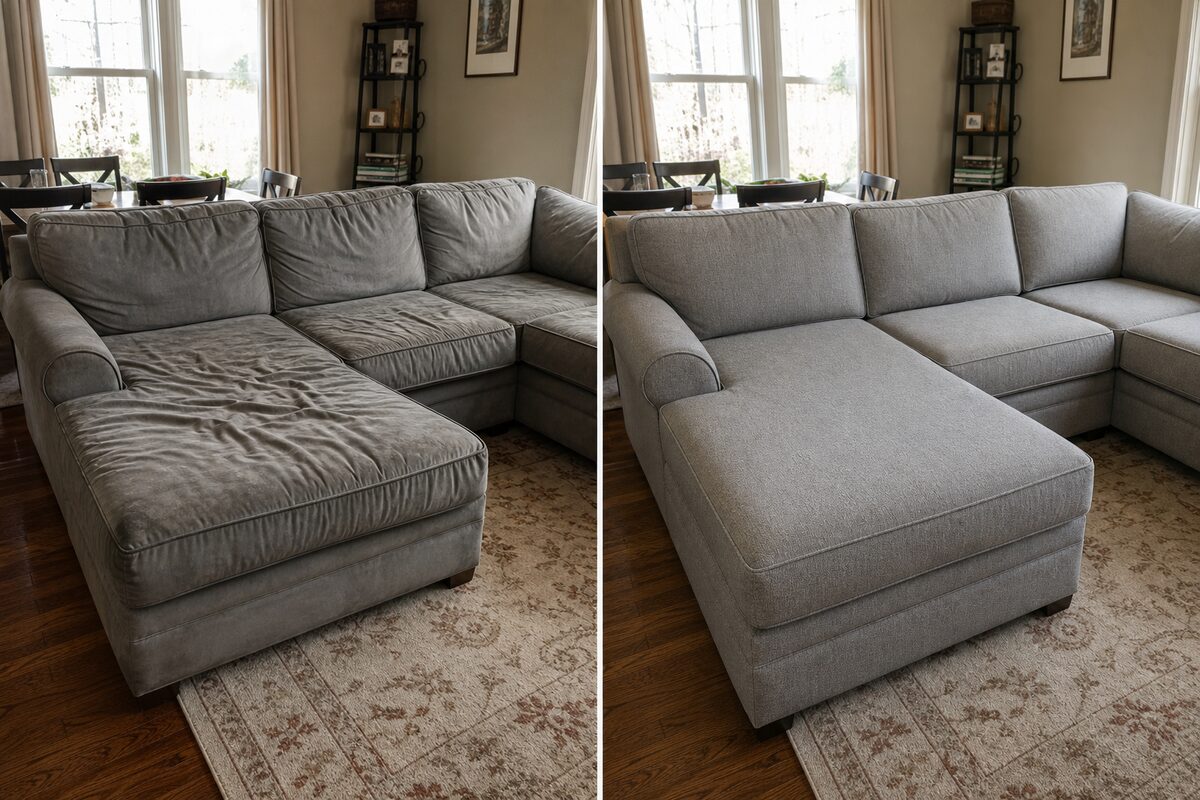
Real projects from our Monmouth County studio. Every couch on this page came in looking tired and left looking brand new.
 Before / After
L-Shape Sectional
Middletown: Performance fabric, new foam, spring repair
 Before / After
Tufted Chesterfield
Rumson: Full-grain leather, button retufting, frame repair
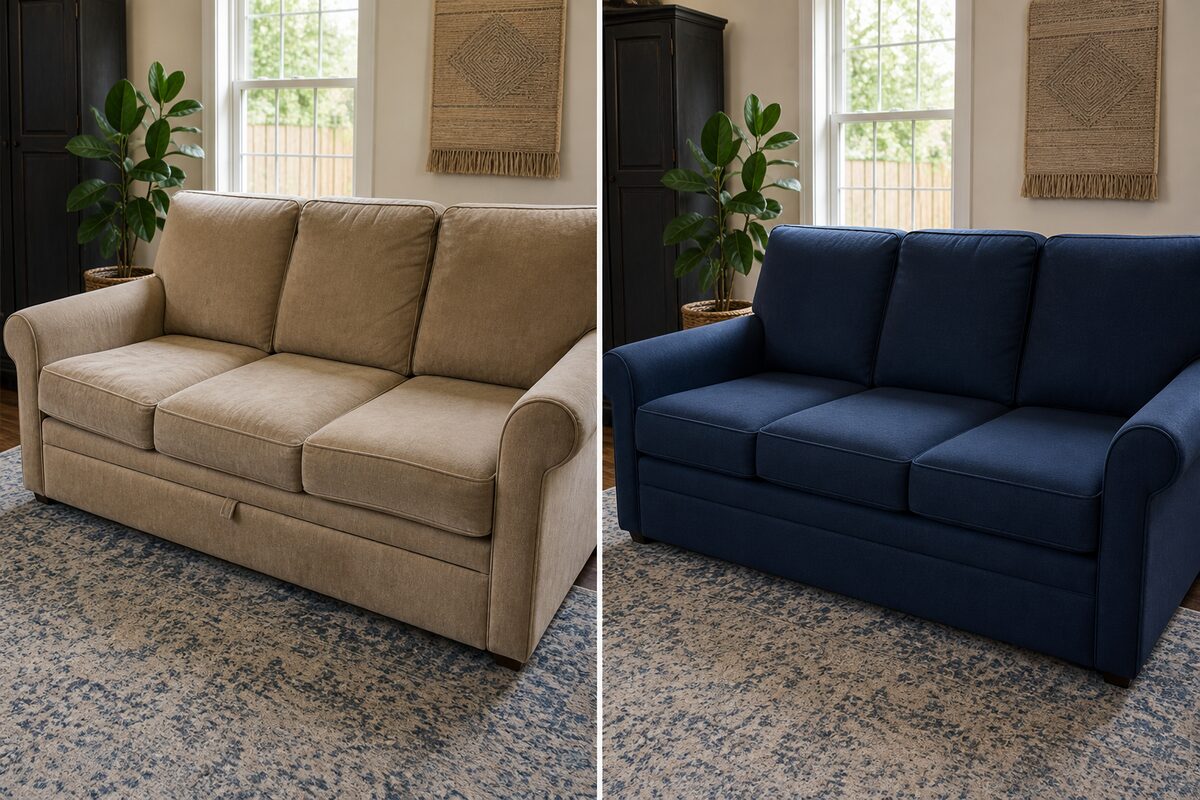 Before / After
Queen Sleeper Sofa
Holmdel: Crypton fabric, new cushion foam, mechanism serviced
 Before / After
Mid-Century Modern Sofa
Red Bank: Wool blend, Dacron-wrapped foam, leg refinishing
 Before / After
Camelback Loveseat
Marlboro: Linen blend, eight-way hand-tied springs retied
 Before / After
Three-Seat Leather Sofa
Colts Neck: Top-grain leather, full foam replacement, arm cap repair
What Affects the Cost of Sofa Reupholstery
Every couch is different, so we quote each project individually. We never give vague ranges or bait-and-switch pricing. You get an exact number before we start, and that number does not change unless you ask for additional work. Here are the main factors that determine your quote.
Sofa Size
A loveseat uses less fabric and labor than a full sectional
Fabric Selection
Performance fabrics, leather, and premium textiles vary in price per yard
Design Complexity
Button tufting, piping, skirts, and curved panels add labor time
Structural Repairs
Frame repair, spring work, and webbing replacement if needed
Cushion Rebuilding
Foam density, Dacron wrapping, and back cushion fill type
Pickup & Delivery
Free within central Monmouth County, small fee for outer areas
A standard three-seat sofa reupholstery in a mid-range performance fabric typically runs between $1,200 and $2,500. Sectionals range from $2,000 to $4,500 depending on configuration. We provide free estimates on every project with no obligation.

Leather and Premium Options
Leather reupholstery starts around $2,500 for a standard sofa. These are rough ranges to give you a starting point. Your actual quote will be based on the specific details of your piece. There is never any obligation or pressure to move forward.
Understanding Fabric Pricing
Fabric is usually the single biggest variable in a reupholstery quote. Entry-level upholstery fabrics run $15 to $30 per yard. Mid-range performance fabrics like Crypton, Revolution, and Sunbrella indoor typically fall in the $30 to $60 per yard range. Premium designer fabrics, imported textiles, and specialty weaves can run $60 to $150 or more per yard. A standard three-seat sofa needs approximately 14 to 18 yards of 54-inch-wide fabric depending on the style, so the fabric choice alone can swing the total cost by $500 to $1,500 or more. We carry samples across every price point and will help you find options that balance your budget with the look and durability you want.
Why Quality Labor Costs What It Does
A skilled upholsterer with years of training and experience is not cutting and sewing fabric on an assembly line. Each sofa is a custom project that requires measuring, pattern-making, precision cutting, sewing, fitting, stretching, and stapling by hand. The labor on a standard sofa takes 20 to 30 hours depending on complexity. Tufted pieces, curved panels, and pieces with welting or decorative trim take longer. This is hands-on craftsmanship that cannot be rushed or automated without compromising the result. When you see a reupholstery quote that seems high, it is almost always because the labor hours are significant, and those hours are what produce a finished piece that looks professional rather than homemade.
Sofa Reupholstery Questions Answered
Straight answers to the questions we hear most often from homeowners across Monmouth County.
Couch Reupholstery Across Monmouth County
We provide sofa reupholstery with pickup and delivery throughout all 53 municipalities in Monmouth County, NJ. No need to rent a truck or figure out logistics. We handle everything.
Your Sofa Deserves a Second Life
Whether it is a family couch that has seen better days or an heirloom piece that deserves fresh fabric, we are here to make it happen. Free estimates, honest advice, no pressure.